Know what you control
A login gets you into a platform. It does not always tell you who controls the account, billing, recovery, or the underlying asset. We document what is verified, what is uncertain, and what may be controlled by a third party.
Digital Ownership Governance
You built the business. Then came the website, customer-facing links, shared files, social accounts, contractors, and a few tools nobody remembers signing up for. We help you see what your business depends on, who can access it, and where the experience you promise customers may be getting lost.
Explore The Visibility Gap Audit™For founders ready to see what is really behind the business.
Where the gaps hide
A growing business can have a polished public presence and still be unsure who controls the domain, who can change a customer-facing platform, or what happens when a collaborator leaves. CTGC finds those gaps, translates the confusion, and turns scattered activity into structured business assets.
A login gets you into a platform. It does not always tell you who controls the account, billing, recovery, or the underlying asset. We document what is verified, what is uncertain, and what may be controlled by a third party.
Look at who has administrator rights, what former team members or vendors can still reach, and whether recovery depends on a single person or device. The goal is a usable access picture, not a list of passwords.
Follow the path a customer actually takes: discovery, website, booking, confirmation, and follow-up. A polished front door can still lead to an outdated page, broken link, or message that no longer matches your business.
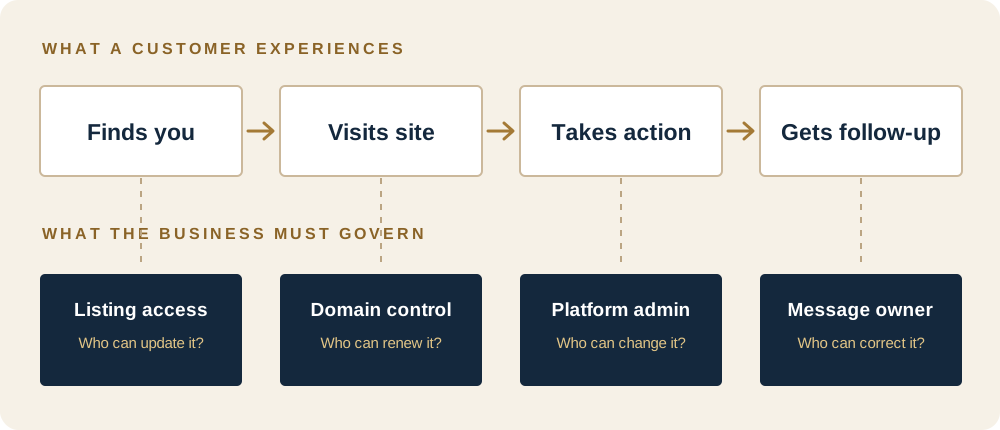
One customer journey, several points of control
Your customer sees one business. Behind that experience, different accounts, administrators, vendors, and automations may each hold a piece of the path.
The starting point
This is the place to start when you know your digital world has grown but cannot see it all at once. We review the accounts, assets, access, and customer-facing handoffs your business relies on. You leave with a clearer picture of what you can verify, where questions remain, and what to address first.
What you receive
Services & starting prices
These are focused diagnostic reviews. The right scope depends on the number of assets, people, platforms, and handoffs involved. You receive a written scope and fee before work begins.
Focused control review
For the founder asking: “Do we control our critical accounts, and who can get in?”
Typical review: 5–7 business days
Includes an ownership and access matrix, recovery checklist, and prioritized corrections.
Public-facing review
For the founder asking: “Does our digital presence reflect the business we operate today?”
Typical review: 7–10 business days
Includes a findings report, customer pathway map, and correction priorities.
Comprehensive review
For the founder asking: “What does our business depend on digitally, and what needs attention first?”
Typical review: 7–15 business days; expanded scope is quoted individually
Includes a findings report, asset and access records, priority plan, 30/60/90-day roadmap, and debrief.
Starting prices are in USD. The reviews document findings and recommendations; hands-on corrections, specialist work, and ongoing oversight are separately scoped. We’ll help you choose the right review rather than assume everyone needs the full audit.
Unsure which fits? Tell me what feels unclear.What working together looks like
You do not need to arrive with a perfect list of every account. We start with what you know and document what still needs to be found.
We discuss your business, the tools you rely on, recent changes, and the questions that prompted you to reach out. Together, we agree on the scope and what information is needed.
We organize the accounts and assets you can identify, review roles and handoffs in scope, and distinguish confirmed ownership from open questions. We do not label an assumption as a verified fact.
We walk through the findings and separate urgent access or continuity concerns from routine cleanup. You get a practical order of action and a record you can use after the review.
How CTGC thinks through a gap
These fictional scenarios show the questions a review would ask. They are examples of the method, not past client results.
A customer clicks to book and sees services the business no longer offers. The contractor who set up the booking platform has left.
A small consulting firm pays for its website, but a former agency registered the domain under its own account. The site still loads, so nobody has checked renewal or recovery.
Own What You Build.
 Ownership.
Before you reach out
We will agree on the scope and your participation before work begins. Expect an initial conversation, some guided information gathering, and a findings review. The time involved depends on how many accounts, people, and handoffs are in scope.
Please do not email passwords or recovery codes. We begin with information you can share safely, such as account names, roles, screenshots, or a guided walkthrough. Any additional access needed for an agreed review should be discussed in advance, with the minimum access appropriate to the task.
That is exactly the kind of uncertainty we document. We distinguish verified ownership from partial or unverified control, then identify the next question or person needed to resolve it. We do not claim to transfer an asset simply by identifying a gap.
Starting prices and typical review times are listed above. We confirm the assets, touchpoints, and complexity in scope, then provide a written fee and schedule before you commit.
CTGC reviews business ownership records, access practices, operational continuity, and brand handoffs. When a finding needs legal advice, a technical security assessment, or incident response, we identify that boundary and recommend involving the appropriate specialist.

Lisa J. Harris is the Founder and Principal of Close The Gap Consulting Co. (CTGC), a Digital Ownership Governance Specialist, and the creator of The Visibility Gap Audit™. She helps founders close the gap between using digital tools and governing the assets, access, and decisions behind them—turning complex questions into clear next steps.
Lisa’s interest in AI began in 2020, before generative AI became a mainstream business conversation. A lifelong learner, she earned certifications in Prompt Engineering from Vanderbilt University and AI Business Strategy from Johns Hopkins University. She later founded AI Business Academy™, an education initiative that helped entrepreneurs and small business owners understand and apply AI. That experience strengthened her ability to translate emerging technology into practical business decisions.
Managing multiple ventures taught Lisa that knowing who holds the login does not always give an owner a clear view of everything the business relies on. Content, platforms, subscriptions, workflows, and brand assets can spread across systems. The harder question becomes how those pieces connect, what still serves the business, and what needs attention when something changes. Her firsthand experience helped shape The Visibility Gap Audit™ and CTGC’s focus on digital ownership governance.
Today, Lisa helps founders understand and govern the digital assets behind their businesses—so they can own what they build.
Start a conversation
You do not need to know which review fits. Describe the account, handoff, or business change that prompted your question. We can discuss scope and next steps before you decide.